
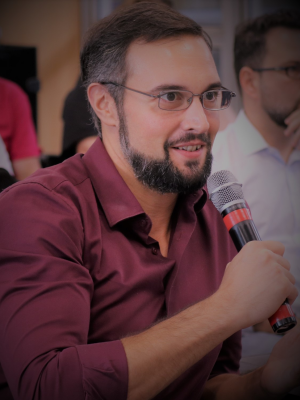
Prof. Dr. Diego A. Falceta-Gonçalves - Full Professor - MS-6 at EACH - University of São Paulo. Holds a Bachelor's degree in Physics with a specialization in Astronomy from the Institute of Physics at the University of São Paulo (2000). Completed a Ph.D. in Astronomy at IAG - University of São Paulo in 2005. Obtained the title of Associate Professor ('Livre-Docente') from the Department of Astronomy at IAG-USP in 2011. Completed postdoctoral research at the University of Wisconsin, USA (2007 - 2008) and the University of St. Andrews, UK (2013 - 2015). Served as an Assistant Professor at Cruzeiro do Sul University (UNICSUL) from 2006 to 2010, where he participated in the creation of the institution’s academic master's program in Astronomy and coordinated the Cruzeiro do Sul itinerant planetarium from 2008 to 2010. At EACH-USP, he established and coordinated the Distance Learning Astronomy Enhancement course for teachers, linked to the INCT-Astrophysics. He was one of the founders of the Bachelor's degree program in Biotechnology at USP. He also served as the Deputy Executive Director of FUVEST (University Foundation for the Entrance Exam of USP). His research focuses on the field of Astronomy, with an emphasis on Plasma Astrophysics, with applications in Stellar, Galactic, and Extragalactic Astrophysics. He is a member of the Brazilian Astronomical Society (SAB), the Brazilian Society for the Advancement of Science (SBPC), and the International Astronomical Union (IAU)
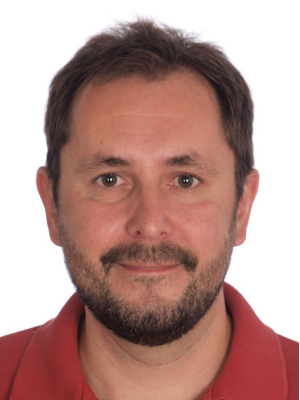
Prof. Dr. Grzegorz Kowal is an Associate Professor (MS-5.2) at the School of Arts, Sciences and Humanities of the University of São Paulo (EACH-USP), Brazil. He obtained his Habilitation (Livre-Docência) from the University of São Paulo in 2024 and his Ph.D. in Astronomy from Jagiellonian University, Poland, in 2006. He held postdoctoral research positions at the University of Wisconsin–Madison (USA), the Institute of Astronomy, Geophysics and Atmospheric Sciences of the University of São Paulo (IAG-USP), EACH-USP, and Universidade Cruzeiro do Sul. He has extensive international research experience in theoretical and computational astrophysics, specializing in astrophysical plasmas, magnetohydrodynamics, and high-energy astrophysics.
His research focuses on the fundamental physical processes governing the dynamics and evolution of magnetized astrophysical plasmas, with particular emphasis on magnetohydrodynamic turbulence, magnetic reconnection, plasma instabilities, magnetic field amplification, and energetic particle acceleration. He develops theoretical models, numerical methods, and high-resolution computational simulations to investigate energy conversion and dissipation in collisional and collisionless plasmas, including nonrelativistic and relativistic regimes. His main research interests include bridging fluid and kinetic descriptions of plasmas, particularly through magnetohydrodynamic models incorporating pressure anisotropy, and understanding the nonlinear interaction between turbulence and magnetic reconnection and its implications for cosmic-ray acceleration. Applications encompass solar physics and space weather, the interstellar and intracluster media, astrophysical jets, active galactic nuclei, and other high-energy astrophysical sources.
He is the Principal Investigator of a São Paulo Research Foundation (FAPESP) Young Investigator Grant – Phase 2 (Grant No. 2021/06502-4), dedicated to investigating the interplay between turbulence, magnetic reconnection, and cosmic-ray production in nonrelativistic and relativistic astrophysical plasmas. He also leads a FAPESP Multiuser Equipment Project (Grant No. 2022/03972-2), focused on establishing high-performance computing infrastructure for scientific research. Previously, he was the Principal Investigator of a FAPESP Young Investigator Grant (Grant No. 2013/04073-2) and participated in FAPESP Thematic and Strategic Research Projects. His work includes the development and application of computational tools for numerical simulations of magnetized plasmas, with an emphasis on scientific software dissemination and reproducibility of research results.
He is actively involved in the training and supervision of researchers, participating in graduate programs and supervising or co-supervising research in astrophysical plasmas and high-energy astrophysics, alongside undergraduate teaching activities at the University of São Paulo. He has an extensive publication record in international peer-reviewed journals, including The Astrophysical Journal and Physical Review Letters, and maintains active national and international scientific collaborations, including participation in the Cherenkov Telescope Array Observatory (CTAO). He regularly serves as a referee for international scientific journals and as a reviewer of research proposals for national and international funding agencies.